The capacity building of various stakeholders on Indigenous Peace Mechanisms in the Rwenzori region
- 4 months Ago
- 0 Comment
- 8 Min Read
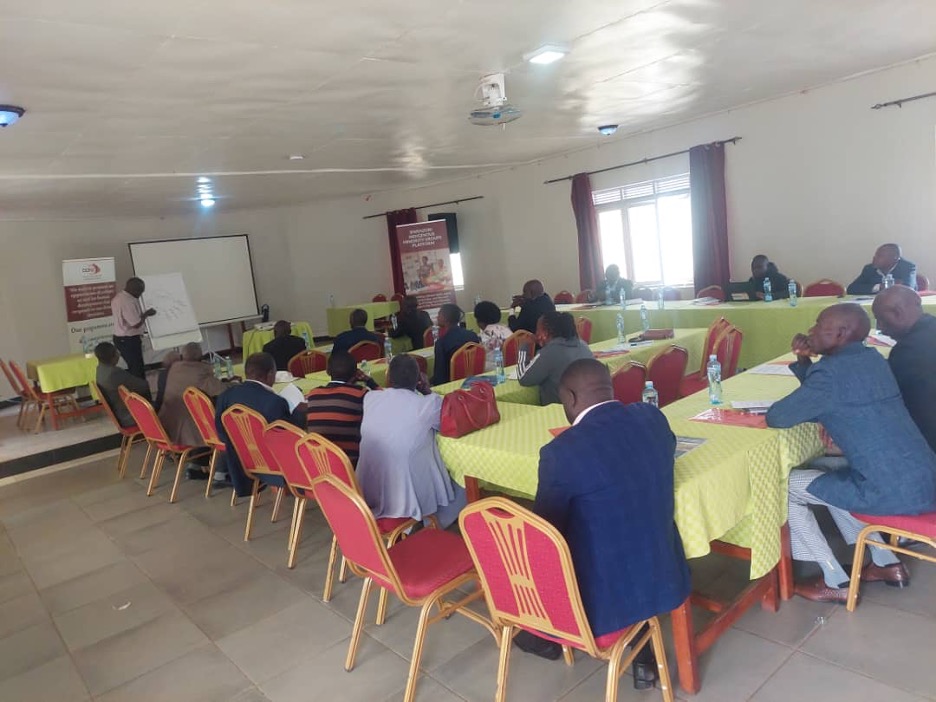
The Cross-Cultural Foundation of Uganda (CCFU), in partnership with the Rwenzori Indigenous Minority Groups platform, conducted a two-day capacity enhancement training for local government officials, cultural leaders, civil society actors, and Indigenous Minority Groups leaders drawn from the Rwenzori region to revitalize and utilize Indigenous Peace Mechanisms to contribute to social cohesion in the region. The training took place on September 9th and 10th, 2025, at the New Fort View Hotel in Fort Portal Tourism city.
The training was intended to enhance the capacity of state and non-state actors to identify, appreciate, and utilize Indigenous Peace Mechanisms in managing conflicts in the Rwenzori region and to discuss strategies of mainstreaming Indigenous Peace Mechanisms in existing conflict resolution and management interventions in the Rwenzori region.
In his welcome remarks, the chairperson of the Rwenzori IMGs platform, Mr. Emmanuel Kyalimpa, talked about the platform and its objectives, one of which is the use of a cultural approach (Indigenous Peace Mechanisms) to ensure peace and harmony, given that even after various interventions by the government, peace is still lacking.
The Chief Administrative Officer for Kasese district, Mr. Walakira, urged the IMGs to practice the culture of saving and emphasized the need for them to work hard, educate children, and tap into resource opportunities to sustain themselves. He posed two questions for IMGs to reflect on, including whether IMGs who take a higher step in life give a supporting hand to others who are still struggling, and whether the ones still struggling call for help.
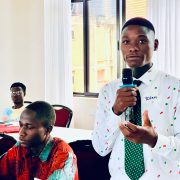
During the brainstorming session on key concepts like Peace, conflicts (nature and causes), and Indigenous Peace Mechanisms (IPMs)/Alternative Dispute Resolution (ADR), Fredrick Nsibambi explained the reason for inviting representatives from the local government, saying that they hold important offices through which such conversations are held. He continued that the implementation and understanding of what we have (as IMGs) has not been well pressed, and so there is a need to start pressing what we have (Indigenous peace mechanisms) by understanding what they are and how they work. These Indigenous Peace Mechanisms include: Omusakano/Omukago (blood pact/Convenant ritual), Olhusumba (Collective circumcision), Intermarriages across cultural communities, Totems, Isaazi/Ishaazi (Courtyard), Joint economic activities and interdependence, and Taboos. He also presented the analysis of Indigenous Peace Mechanisms established during the research, and explained the rationale for the research that was conducted.
Day one was concluded with a debate whose motion was that contemporary conflict management mechanisms are better than the Indigenous conflict management mechanisms. Participants were divided into two groups. One group defended the use of contemporary mechanisms for conflict management, while the other supported Indigenous conflict management approaches.
The group that supported contemporary mechanisms argued that formal courts of law are available everywhere (at national and international levels), so there is no need for one to resort to indigenous mechanisms that are documented. There is fairness given that the decision of the judge is based on technicalities.
The group that supported indigenous conflict management systems on the other hand, argued that the formal mechanisms dispose communities of their knowledge and power to make decisions; the modern systems have been commercialized; the IPMs protect intergenerational transfer of knowledge and properties; formal courts are too expensive and characterized by corruption; IPMs are more reconciliatory and preventive in nature; they provide wholistic justice (social, spiritual and nature, etc.
Participants further had an opportunity to carry out a stakeholder mapping exercise to identify institutions and individuals who might be useful to implement the IPMs. Some of the institutions and individuals identified include Uganda Wildlife Authority, Police, Ministry of Gender, Labour and Social Development, elders/clan leaders, religious leaders, native healers, parliament, and para-social workers, among others.
Day Two

The King of the Basongora gives his views
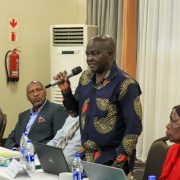
Day two started with a recap of what had transpired on day one. The participants highlighted several issues that stood out to them on day one. “The debate was outstanding. It can be done in our local languages and replicated in the communities. It reminded us of the primary school life,” noted one of the participants. They further learnt new terms and approaches to conflict management. Not all conflict-related cases must be taken to courts of law. “We need to look at the two sides, both contemporary and traditional, if we want to resolve conflicts effectively. We should have defined IPMs as a collection of our wisdom rituals, values, and attitudes that bring harmony, love, and peace in our societies,” a participant explained. The mapping exercise was appreciated for helping the participants to understand who to work with to promote peace and dialogue. Participants further noted that there is a need to include the judiciary during the conversations about IPMs.
During the presentation on legal pluralism and Peace, concerns raised included the status of the forests after inhabitants were evicted and the status of living for the evicted people. It was urged that if Uganda Wildlife Authority doesn’t co-opt the owners of the resources to manage them, then it won’t go far in conserving such resources.
Reflections for CCFU
- Regional festivals for IMGs to showcase their culture
- Engaging and building the capacity of judges because most of them do not understand cultural rights.
- Having a ministry of Peace, Unity, and Harmony
- Holding a Truth and Reconciliation conference (TRC) for cultural institutions
Action Points for IMGs
- Creation of a desk in cultural institutions handling peace, unity, and harmony using Indigenous Peace Mechanisms (IPMs)
- Holding conversations on how to use the IPMs to obtain peace in various regions
- Continue engaging authorities like UWA to advocate for c-management of resources
Support visits to groups implementing the Cultural Enterprise Project
From 10th to 12th, the Cross-Cultural Foundation of Uganda conducted support visits to three cultural groups that received subgrants for their culturally related business projects. These included the Izinga Lya Bagabu in Kasese, Bahumakati Haven Group (Basongora women) in Nyakatonzi, and Rwebisengo Women Cultural Association (Batuku) in Ntoroko district. These visits were aimed at checking on the status of these groups and discussing how far they have gone with the implementation of the project according to their work plans, challenges faced, and the way forward.
Izinga Lya Bagabu
The 1st disbursement of funds was sent to Emma Kyalimpa’s account, who did not deliver the money to the group but rather implemented the 1st stage of the project individually (Igabu Cultural Centre), something that didn’t go well with the elders, who claim that what Emma did was for his selfish interests and not for the good of the Bagabu. It was also raised that Emma Kyalimpa no longer invites elders for the Rwenzori IMG platform meetings since he became the chairperson, but rather, he invites other people he wishes.
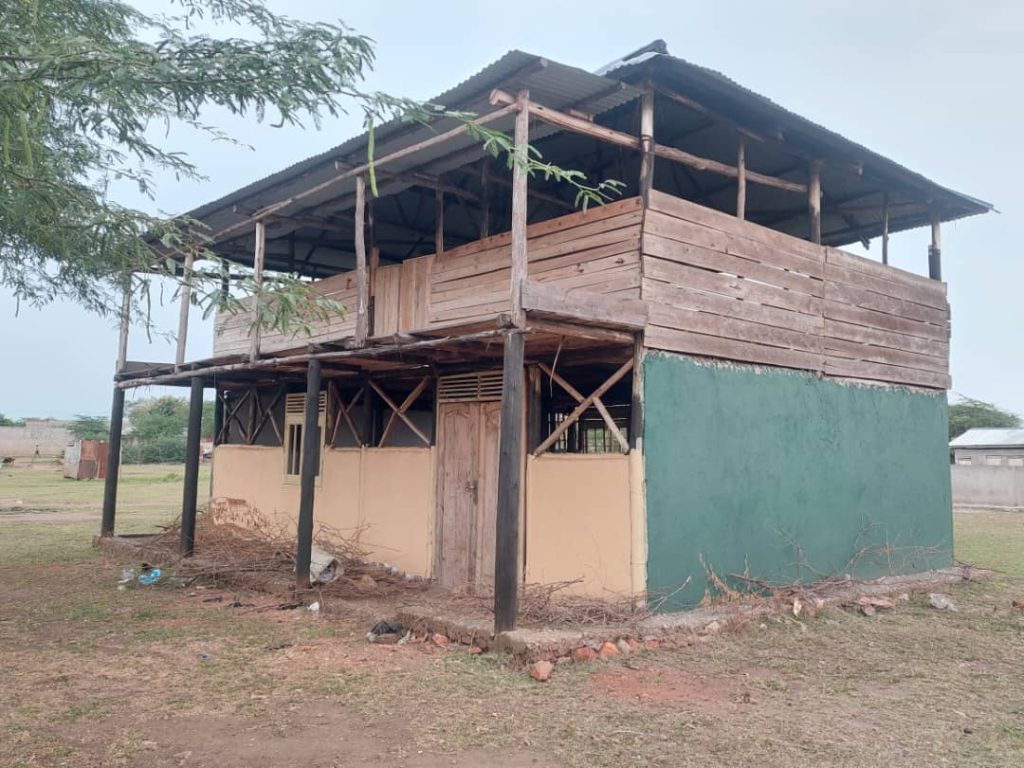
One of the structures constructed as part of the project work
Action points for the Izinga Lya Bagabu
Encourage the Bagabu to work as a team and form a management committee for the Izinga Lya Bagabu Cultural Centre
Emma Kyalimpa to sign an MoU with the elders of the Izinga Lya Bagabu indicating various roles and responsibilities for all parties concerning the management of the Igabu Cultural Centre.
Reflection for CCFU
Doing proper ground studies before disbursing funds.
Bahumakati Haven Group (Basongora women)
Most of the planned activities, including opening a bank account, buying six cows, and buying obutambi, have been implemented. They said that they have not yet faced any big challenge and that one of the lessons learnt is on widening the market for their products.
They also reported that they paused the idea of the signpost because they have not yet got a permanent workplace. They used savings from buying cows to buy Obutambi.
Action Points for the Group
- Buying Emigamba
- Muhwezi Isaac to reach out to CCFU concerning the brochures
- Acquire a receipt book for proper accountability.
- Disburse the second instalment
Reflection for CCFU
Think of buying them a laptop. (later)
Rwebisengo Widows Cultural Association
Rent was a big challenge for them since all their profits would be used to clear rent, which CCFU helped to solve by providing funds that were used to acquire land on lease and also set up their container.
A sewing machine was bought, and some people are being taught how to use it.
Action Points for the group
- Disburse funds for a fridge and support electricity installation.
- Fundraising
Future Plans for the Group
- Change of the group’s name
- Official launch of the association
- Buying land
- Construct a cultural centre
- Reach out to schools on culture
Visiting the Batwa Cocoa Garden in Bundibugyo
CCFU also paid a visit to the Batwa garden, where Cocoa was planted for their benefit. Some cocoa seedlings have been cut by people to whom the land was hired. Replacements for the former are to be done by Richard Mugume from ICAM in Bundibugyo.
Action points
Richard Mugume to hold a meeting with the Batwa, the people to whom land was hired, and the local council to see how various concerns, including the unnecessary cutting of the cocoa, theft of crops by the Batwa and others, can be addressed.